September 6, 2010
Tags: aphids, plant wall
I’m still battling aphids in the plant wall, but I am making headway. Instead of seeing a dozen, I’m seeing an occasional very lethargic speck of green with legs.
Jill at JMH Water Gardens gave me a recipe for a fish safe aphid spray that seems to be working really well. The fish are alive and the aphids aren’t. I see that as being the measure of success. Oh, did I mention it’s cheap to make out of common stuff? Yeah, that too. Blend oil into a beaten egg white, store in the fridge.
Jill’s recipe says 1 cup of oil to 1 tbsp of egg white. I confess to not being that precise. Store in the fridge, mix a bit with water in a spray bottle and spray. I did say I wasn’t that precise, didn’t I? Her instructions say 2½ tsp of the egg/oil mix to 1 cup of water. I don’t need that much at a time so I mix a little over a teaspoon to ½ cup of water. Spray as needed. It doesn’t keep so dump what you don’t use right away and mix new each time you need it.
August 22, 2010
Tags: grow bed, hydroton, lettuce
I’ve gotten four meals of lettuce out of my growbed so far. I don’t have a lot of lettuce in the bed . . . I should have a lot more. I’m supplementing with store bought lettuce.
I found a place to get hydroton in Olympia. It was max expensive, $40 a bag when the going rate is closer to $28. I bought two bags. That should be enough to fill both growbeds with a bit left over.
I pulled the gravel out of the wall gutter and replaced it with hydroton. I also trimmed the heck out of a bunch of plants in the grow wall to allow some slower growing things a little bit of daylight. I put some of the trimmings in the gutter along with a couple of sprouting grapefruit seeds.
The orchid in the wall is not doing well. I don’t know if it will recover or not. Time will tell. I should have moved it ages ago.
I long ago faced my addiction to plants and decided it was not a bad thing.
August 17, 2010
Tags: plant wall

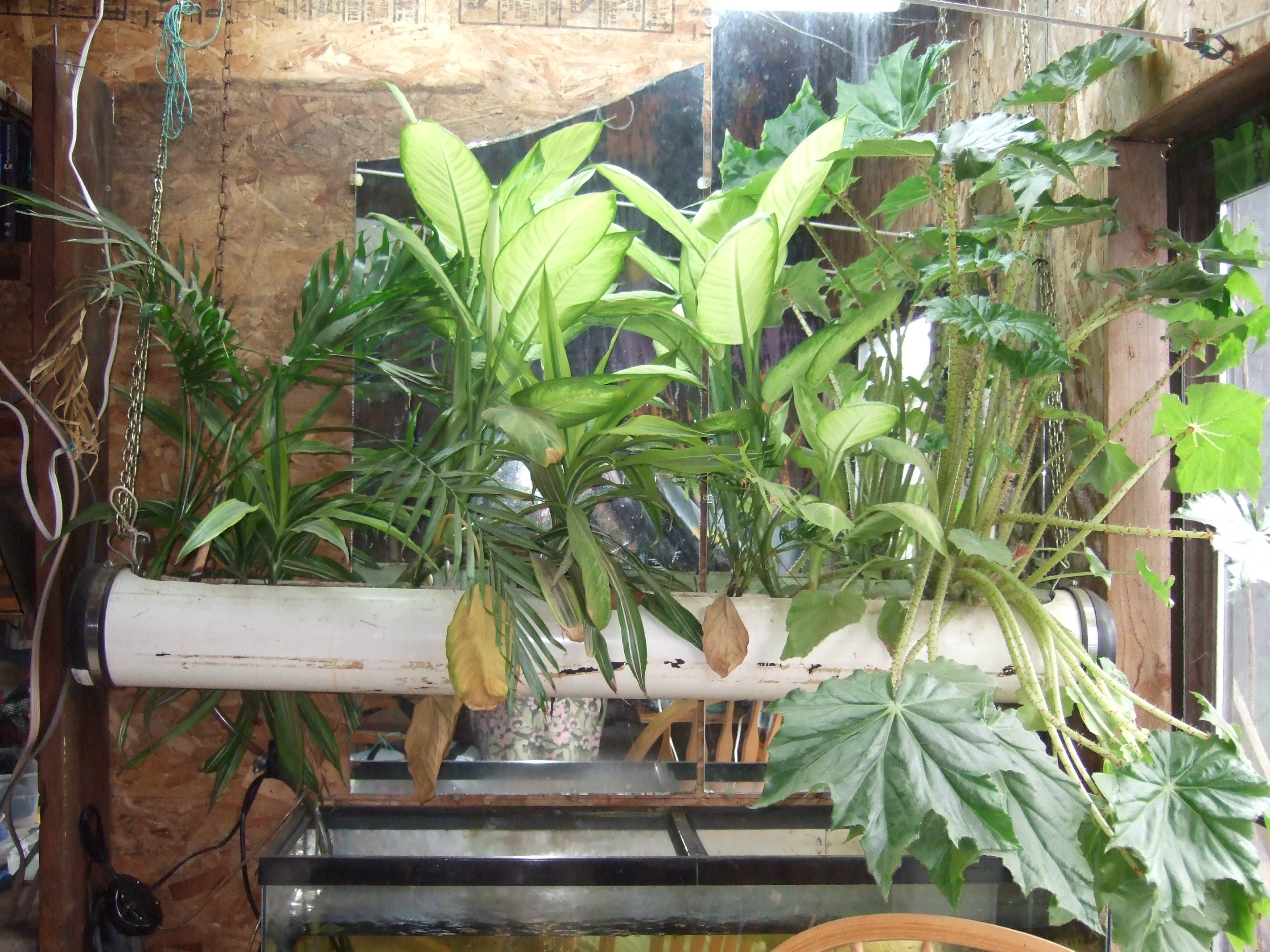
Wall in profile with ricinifolia Immense on display.
I was forced to shuffle plants around in the plant wall. Terry couldn’t feed his fish without having to fight through the ricinifolia Immense, and the plant was happily increasing in size. The largest leaf is over 18″ long on a 2′ long stalk. As the leaves matured the situation was going to get much worse, so decisions had to be made.
To reconfigure the wall I pulled a areca palm on the left side of the wall and increased the opening and installed one of the begonias. Then I cut another opening in a blank spot and installed the other, removing the majority of the large leaves at the base of the plants.

Orchid is the stick at the very right of the wall half-way up, the Immense begonia is on the left and the new philodendron is center right.
I pulled the orchid and put it in a new spot against the right side of the wall next to the window and put a split leaf philodendron in the spot where the largest begonia was removed. This fills in the spot and gets the orchid out to where it’s not so crowded.
I was amazed when I pulled the ricinifolia Immense how little root it had added since being installed in the wall. It had not much more root than when I put it in the wall, but the leaves were getting . . . well . . . IMMENSE.
Now Wadly can get to his tank to feed his fish without having to do it by braille.
August 6, 2010
Tags: plant wall

Current state of the wall
With the surrounding plants pulled away to sweep and clean, it’s time to take a picture. Yes, the Hawaiian begonia really is that big. The leaf showing fully to the camera is 17″ long. The stem it is on is 23″ long. The largest leaf is over 18″ long. It is immense. Click the picture for more detail.
Everything is filling in nicely. I’ll use this time to put one more plant in the wall and clean up dead foliage.
When the new house is up (years in the future) I’ll have a plant wall whose system spans two rooms. I’ll put the aquarium in the tv room where it can shine. The plant wall will be on the other side of the wall in the living room where it can get lots of natural light and act as an art piece on the wall.
July 24, 2010
Tags: plant wall

Ricinifolia 'Immense'
It turns out the big begonia in my wall is Ricinifolia Immense, a rhizomatous variety.
I got a start for my ricinifolia Immense from a friend over 20 years ago. I’ve propagated it, given friends starts, passed my plant on to someone else and just lately got a start back. This plant LOVES being in the plant wall. The growth is more lush than when it was potted. The leaves are bigger, the stalks are longer. The largest leaf on this new start is 17″ long and over 13″ wide. The stem is a full 2 feet long. This new start hasn’t bloomed yet. I don’t expect to see a bloom stalk until this fall.
And I’ll be really glad when the weak chlorotic leaves age and fall off . . .
July 23, 2010
Tags: plant wall

Chlorotic leaves
It’s important to note the plants in the wall aren’t going to get everything they need from the fish. From this I’m going to extrapolate that the fish aren’t getting everything they need from the fish food.
If you look at the two leaves in the picture, you’ll see one is chlorotic (showing insufficient chlorophyll from deficiencies in nutrition aka splotchy color). The leaf on the right, the chlorotic one, is the older leaf. The leaf on the left is healthy with a much more even distribution of chlorophyll. The leaf on the left is new, appearing after I sprayed the wall with worm casting tea.
So I extrapolate . . . if the plants are getting incomplete nutrition from the fish, the fish are getting incomplete nutrition from the food they are eating.
July 1, 2010

Tangled and lush understory
As the plants in the wall grow and mature, the understory becomes denser. In daylight (this picture was taken in the dark using just the flash for illumination) there are small sections of the felt visible at the very top and bottom of the wall. In the body of the wall you have to dig in behind the protruding leaves to see any of the structural felt.
In the center of the picture is a dieffenbachia leaf that has grown in size to be much larger than anything the parent plant produced.
I love the colors and textures in the wall.

Shiny leaves but no blossoms
I have a piece of hoya in the wall and the leaves look beautiful, shiny and healthy, but it hasn’t produced new growth nor has it blossomed. The parent plant has some new growth and also hasn’t blossomed.
I bought this plant for the variegated leaf not knowing what kind of blossom it would have. It’s disheartening to think I may never know . . .

Hairy begonia stems
As a Hawaiian begonia stem matures, it develops hairs along the stem. The hairs are an indicator of plant health and established root structure. Take a minute to click on the image to see the hairs in all their glory.
The spots on some of the leaves are left-overs from the worm casting tea.
Above the hairy stem is the new orchid blossom shoot. Look how much it’s grown.
This picture was taken at night with all the lights off. I used a flashlight to line up the camera. The camera’s flash does a great job of lighting up the wall’s landscape.
June 28, 2010

Closeup of mature wall
Patrick Blanc’s work is the inspiration for my plant wall. In a search for new vertical garden stuff, I ran across this closeup of one of his projects.
I found this fascinating. Watch the leaves move over the course of three days.
June 23, 2010

Almost full sized
The Hawaiian Begonia’s biggest leaf is almost the max size it will get. This leaf is about the right length but isn’t quite the full width yet.
June 5, 2010
One of the really good organic solutions for six legged pests is worm casting tea. I make a really small amount, but if you need to treat a bigger area, it’s easy to make more. Thanks to Ray on the Barrelponics Yahoo group for the instruction.
You’ll need a small airstone and a air pump. My aquarium air pump has two ports so I plug into the spare for making worm casting tea.
I’m giving the instructions for a quart, as that’s the amount I can make and use up before it’s not any good any more. It needs to be used within (if memory serves) a couple days.
For a quart, use filtered water, add 1.25 ounces of worm castings, drop the airstone in the bottom and let it bubble away for 12-24 hours.
Strain it and spray it where you need it taking care to get the under side of the leaves as well as the stems and tops.
Here’s the bonus bit. It’s perfectly safe for plant walls and aquaponic systems. Can’t beat that!

The leaf isn't fully formed but it's showing great promise.
At least one of the wood fern planted in the left side of the wall is doing really well. The potted plants that sit in front of the wall block me from doing a close inspection so I have to wait until something pokes out into view or pull the pots away from the wall. The pots weigh over 100 lbs apiece and I’m not yet curious enough to go to the effort of moving all three. It won’t be long before the avocado goes out side for the summer. Maybe then I’ll pull the pots away and take a good look.
The bright green spikey bits above the wood fern is the rain forest flowering cactus from Honduras/Nicaragua . . . heliocereus. The plant is growing really fast . . . over 36″ of new growth just in that section of the plant since it went in the wall. That’s a lot of growth.
The dumb canes (light green leaves) are also doing really well. Both plants show good growth.
The dieffenbachia cuttings are also doing well. The parrot’s beak croaked. It wasn’t getting enough light. I’ll start another lower in the wall where it won’t be blocked. The jade plant is still growing, strangely enough.
May 29, 2010

Aphids on the Aphid Trap - smell-good fly paper for aphids.

Orchid blossom stalk is growing apace.

The Hawaiian begonia is starting to pop out of the wall.
It’s almost June, just another day or two to go. The weather outside sucks. It’s cold and rainy and only fit for foul weather fowl. I’ve got stuff I need to do out there, but let’s face it, I’m a weather weeny.
The plant wall is doing well. Terry added two more head-and-tail-light tetras yesterday and a fancy red tailed guppy today. Having the wall keep the aquarium clean allows him to spend his energies admiring his fish instead of cleaning up after them. He had a bit of a panic last night thinking he had a dead fish. It turned out to be a leaf washed into the tank from the wall.
In the wall, the Aphid Chaser is chasing aphids and the Aphid Trap is enticing aphids. The Aphid Chaser truly does chase the aphids off the wall. From observation I’m going to say the aphids move down to get away from the Aphid Chaser. At the bottom is my lettuce and tomato seedling and having the aphids end up there is not an ideal outcome. To counter this I’ve added an aphid trap sheet to the outside edge of the trough and the aphids are traveling right past my seedlings to become stuck to the aphid trap. This I consider an ideal solution.
I added a baby spider to the wall today. Every little bit helps.
I’ve taken a couple other pictures to illustrate what’s happening in the wall.
The new blossom stalk on the orchid is continuing to grow. This really pleases me. I don’t know how long it takes to produce blossoms but I bet I’m going to get some.
Usually when plants are added to the wall there’s a period during which nothing happens. The plants don’t grow, they don’t wilt but they don’t do anything else either. Then all of a sudden the plant is producing flowers and/or new growth.
With the orchid this wasn’t the case. It started growing and is working to produce blossoms. It already had the right roots for this type of planting. It’s happy, I’m happy . . . what more could we want?
The Hawaiian begonia has finally settled in and is beginning to produce the big leaves I remember from the parent plant. The biggest leaf so far is on a 10″ long stalk and is about half the size it will be when the root structure fully adapts. Mature leaves are about the size of a normal dinner plate on a ~12″ stalk. Once the begonia’s roots develop enough to support it, I expect the plant to start producing blossom stalks (30″ long with tiny pink petals down the length of the stalk).
I love the textures, colors and shades in the plant wall. The eclectic variety of plants produces something that warms my heart and soothes my soul.
May 25, 2010

Lettuce seedlings in the wall gutter
I took the largest of the tomato seedlings from the wall gutter and planted them in the growbed outside. Then it hailed and we had a spate of cold wet windy weather. The wet part isn’t an issue, but the cold and hail and wind . . . toast. <sigh> I lost half the seedlings I planted out and the last two look like they’re on their last leg. If we get a spate of warm weather they might pull through. If they don’t I’ll put the 4 tomato plants still growing in the gutter in their place . . . when they get significantly bigger AND the weather improves. I have sun shade cloth buffering them just a bit, but a big sheet of plastic would have been better.
I’m adding another growbed to my outside tank. I like the new setup so well I’m going to max out the grow potential of the fish tank. I have to inventory my bulkhead fittings. I need two uniseals the same size for connecting another 5 gallon tank to the existing 5 gallon dump tank. Adding another tank and bed will change the dump time from ~15 minutes to ~30 minutes.
I threw about a dozen lettuce seeds into the plant wall gutter. By they time they’re ready to transplant out I should have the new growbed up and running . . . and warmer weather. <fingers crossed>
May 18, 2010

Gloxinia, Cape Primrose, Begonia and Waffle Plant all showing blossoms
Just a snapshot to show you what’s blooming.
I’ve added the Lightbox Plus plugin so you can now see the image (click to enlarge) without additional navigation.
May 16, 2010
The combo of Aphid Chaser on the plant wall and Aphid and White Fly Trap 6′ away seems to be the ideal solution. I have no more aphids visible on the wall. I think this is an ideal solution. It provides protection for the plants in the wall without impacting the fish in the aquarium.
May 13, 2010
 The center leaf has doubled in size since the orchid was installed in the wall
 The bud on the stalk is developing. |
I’ve been keeping a close eye on the orchid to see what it would do. It’s crammed in in the midst of a lot of other stuff and only gets filtered light. It seems to be quite happy, showing new leaf growth and new bud development on the flower stalk.
Wadly brought home Aphid Chaser yesterday. I pinned two on the wall with stainless steel pins. Aphid Chasers appear to be red foam, about the size of a half sucked away Life-Saver candy.
I moved the Aphid and White Fly trap to the far side of the sliding glass door, away from the plant wall. When I get all the aphids out of the wall I’ll move one of the chasers to the garden window. I don’t have any aphids there and I sure don’t want any.
May 10, 2010
Well, I think I have the answer. I just need to see if I can find this product locally. This looks like the whole answer.
Aphid Chaser
Aphid Chaser uses pheromones to “upsets the insect’s chemical ecology and breaks down communications in aphid colonies. These nontoxic dispensers do not affect beneficial insects <snip>. They act to ward off most common aphid types
I picked up a package of aphid and white fly traps. I will hang one of the Aphid Chasers on the wall and one of the aphid and white fly traps away from the wall and eliminate the problem without spraying. I see this as being an elegant and ideal solution.
I’m still researching how to permanently rid my wall of aphids while doing no damage to the attached aquarium. I pick them off morning and night. Sometimes I don’t find any or just one, other times I’ll find five or six. I’m obviously not clearing them out so will have to find a way to eradicate them permanently.
I ran into this prep in my search.
Several years ago I came across a homemade remedy for aphids that is the best I have found. The recipe is quite simple and safe.
Put a pinch of Chewing Tobacco in a pint of warm water and let set overnight. Do not cover.
Mix 2 Tablespoons tobacco juice and 1 Tablespoon Listerine in 32 ounce spray bottle and fill with water. Add 2 drops of dish washing soap. Be sure and add soap last.
Spray on any of your pond plants as needed. This has never hurt any of my fish or plants.
This was posted on http://www.macarthurwatergardens.com/PondQ&A-Archives/Safe-NaturalCureFor-Aphids.html by “Sharon from Oklahoma”.
I don’t have chewing tobacco or Listerine, but it sounds like an interesting prep.
April 28, 2010

Seedlings
Wadly says he’s got another baby fish in the tank. I’ve laid on the floor and looked but haven’t gotten a glimpse yet. The previous baby grew to be recognizable as a female guppy who is now nearly the same size as the adults.
Wadly stopped at Glacier yesterday and brought home five buckets of pea gravel for me. I’m going to need more to fill my new grow bed (grout mixing pan – 7″x22″x32″), but it’s a good start.
I’m definitely going to fill the gutter with pea gravel and plant things in it. It works too well not to. I’m going to have to rework the overflow to keep the gravel in the gutter. If I could find some hydroton locally I’d use that, as it’s much lighter than gravel, but I haven’t come across any yet.
I’ve got seeds showing growth in three of the five coco coir mats. I’ve got seedlings coming up out of the gravel between the coco coir mats. I’ve got some hollyhock seeds planted in the gravel, lovely purple ones. I’m really looking forward to those popping up.
April 24, 2010
I got a flat tailed salamander for my wall but I think he’s not going to stay in the wall. Wadly found him last night on the rug drying out and caught up in short pieces of thread (I’ve been appliquéing). He put him in a bowl of water and left him overnight. He was fine this morning so I put him back in the wall. The chances of him actually staying there are probably really small. <sigh>
I’ll try tree frogs . . . maybe they’ll stay in the foliage.
April 23, 2010

Seed bed in wall gutter
I’m way behind in getting seeds started for my outdoors grow bed. I brought in the seed starter tray I used last year to start seeds for the three of us. I just couldn’t make myself jump through the hoops.
I cut up some coco coir mat (liner for a wire hanging basket)

Leaves poking out of the coco coir
to use as seed beds in my gutter. I laid a bed of gravel and set the coco coir in so the bottom side is flooded each time the wall is fed.
I planted a range of stuff . . . lettuce, tomatoes, oregano, chives . . . and I already have something showing leaves. If I had to guess I’d say it’s lettuce. Germination is six to fourteen days according to pack. Try four days! How rockin’ is that?! With 80° water warming the seeds it accelerates the germination!
When I get LouAnn’s wall built and her plants are no longer in my gutter I may fill the rest of the gutter with pea gravel and plant it. That would be cool!
April 18, 2010
The solution I sprayed on the wall didn’t kill all the aphids. As they were isolated on bloom stalks I trimmed the infected stalks and have been keeping an eye on the wall. I’m going to have to get some straight trichlorfon for future use. I’ll check at Kaija’s next time I’m there.
We had a fish die. It was either a sword or a platty. I’d had my eye on it for a couple weeks as its abdomen had been getting larger and larger. It finally bit the big one and Wadly fished it out.
Otherwise everyone’s happy and healthy. Wadly built a shelf for the pleco and cats to hide under. I don’t see them under there much but it makes Wadly happy.
April 11, 2010

Aphids on the streptocarpus
Ugh. The wall has aphids. I have been keeping an eye on it because one of the plants sitting on the floor in front of the wall is an aphid attractor. The Beach Oleander I brought back from Hawaii has a continual issue. It must have just the right smell/flavor. I treated it last week for aphids so it’s not surprising they’ve migrated to the wall.
In case you were wondering . . . Cape Primrose and Gloxinia appear to be particularly attractive to aphids.
So, the question is how to treat the wall and not kill the fish. Wadly and I had discussed this a number of times and had developed a strategy we thought would work.
- Unplug the aquarium pump and pull it out of the aquarium.
- Drop the smallest statuary pump into the tank and plug it in to keep the water moving for the duration the wall is separated from the aquarium.
- Siphon out 4 gallons of water into a bucket.
- Top the aquarium up with new water.
- Drop the aquarium pump into the bucket.
- Connect the gutter to the bucket.
- Cover the aquarium with plastic.
- Spray the wall with aphid killing chemicals.
- In 24 hours dump the bucket water and siphon 4 gallons of aquarium water into the bucket.
- Top up the aquarium.
- In 24 hours remove the small statuary pump from the tank.
- Remove the plastic from the aquarium.
- Rinse the aquarium pump and return it to the tank.
- Reconnect the gutter to the aquarium.
- Hope no fish die.
Before we could get started on that process this morning I had a “connect-the-dots” moment. Why not spray the wall with the same mix we use to treat parasites in the aquarium? Duh. The parasite treatment for the aquarium has trichlorfon in it which is an excellent record against aphids. It’s an organophospate noted for its lack of persistence, biodegradability and low cost.
I mixed half a teaspoon of the parasite control with about 3/4 cup of warm water and sprayed the wall. I know it won’t kill the fish. Let’s see if the aphids die. <evil laugh>
April 6, 2010

The first of many blossoms to come
The Cape Primrose (streptocarpus) bloomed yesterday. Isn’t it lovely?
April 2, 2010
 Last day of March . . . still big holes in the wall where the last three plants go
 Begonia blossoms . . . unassuming and unspectacular but nice just the same
 Gloxinia in all its glory
 Primrose getting set to take off |
I still haven’t gotten the last three plants in the plant wall. <sigh> Maybe I can get two of them in today. Everything’s mega-healthy, growing and half of the bloomy stuff is doing just that.
Wadly noticed one of his fish bouncing off a rock on the bottom. That translates to parasite issues with his tank. Monday he dosed his tank with a parasitic that contains sodium chloride (salt). It will be interesting to see how the wall handles an increase in the salt content of the water. He’ll have to dose the tank two more times to ensure full treatment. He’ll empty 25% of the tank water before each of the two additional treatments. That should keep the salt content to a reasonable level so it doesn’t impact the wall plants <fingers crossed>.
The wall gutter makes treatment so easy. Wadly put the granulated prep around the overflow pipe in the gutter. The water flowing through the wall and into the gutter dissolved the granules and carried the treated water down into the tank.
Currently I have blossoms on two begonias (one white, one pink) and the gloxinia and buds on the Cape Primrose and Christmas cactus. We’ll see how everything survives treating the fish.
March 22, 2010

Happy Christmas cactus
The Christmas cactus has developed a bud. What’s up with that? It’s definitely not Christmas!
The challenge with Christmas cactus has been to keep the soil moisture level just right so the plant blossoms and doesn’t drop the bud or blossom prematurely. It looks like that’s not going to be an issue with the plant wall.